

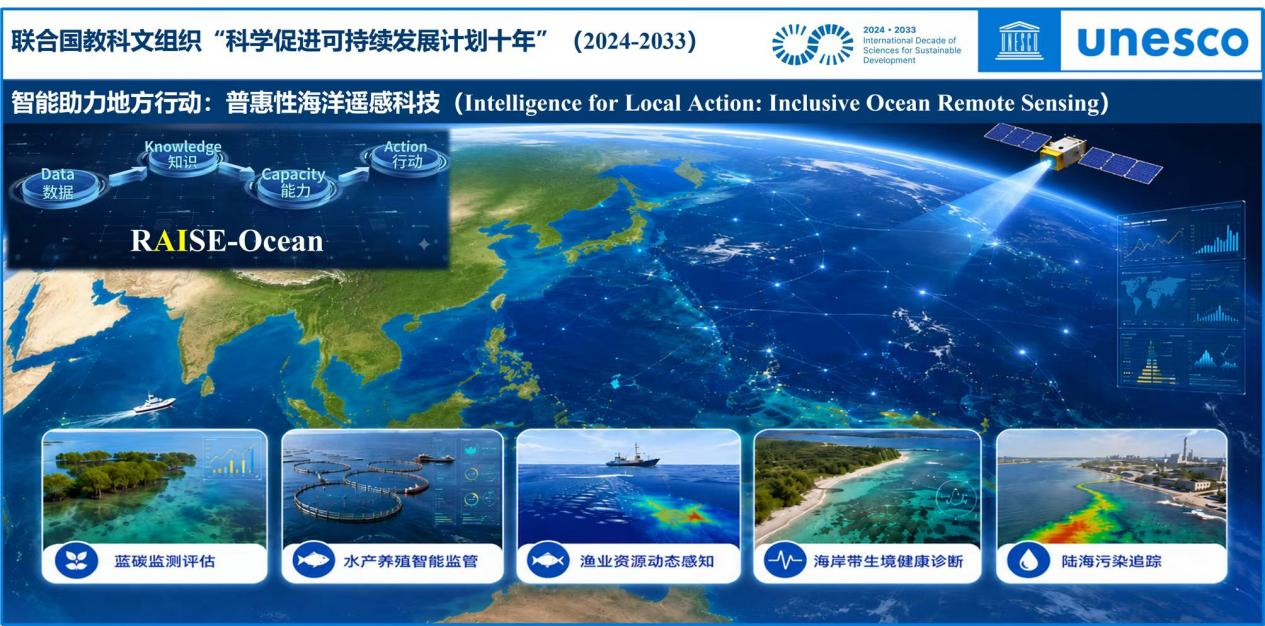
In July, the programme “Intelligence for Local Action: Inclusive Ocean Remote Sensing” (RAISE-Ocean), led by Researcher He Xianqiang from the State Key Laboratory of Satellite Ocean Environment Dynamics of SIO, was officially endorsed by UNESCO. It has been selected into the third batch of Global Programmes of the United Nations Decade of Science for Sustainable Development (2024-2033), making it the first global programme focused on ocean remote-sensing technology under the UN Science Decade framework.
Led by SIO, the RAISE-Ocean Programme brings together researchers from more than ten countries including Australia, France, Sweden, the United Kingdom and the United States. Addressing the insufficient capacity of developing countries and coastal communities in applying big-data and artificial intelligence technologies, the programme will build a remote-sensing-centered empowering chain of “data-knowledge-capacity-action”. It explores an innovative paradigm of “open global remote-sensing data + sovereign local data + collaborative AI evolution”. Focusing on five key areas, i.e., blue carbon monitoring and assessment, intelligent supervision of aquaculture, dynamic perception of fishery resources, diagnosis of coastal habitat health, and land-sea pollution tracing, the programme will develop modular digital toolkits and generate knowledge products readily available for management-decision-making, so as to provide scientific support for achieving the Sustainable Development Goals.
This marks the second global programme led by SIO under the UN Science Decade, following “Promoting Research on Ocean Sustainability: Predictive Ecosystems Resilience” (PROS-Eco). It demonstrates that SIO has gradually built a complete innovation chain ranging from fundamental research to application-oriented services in marine satellite remote sensing, numerical simulation and three-dimensional ocean observation, and acquired systematic capacity to lead and organize international large-scale scientific programmes.